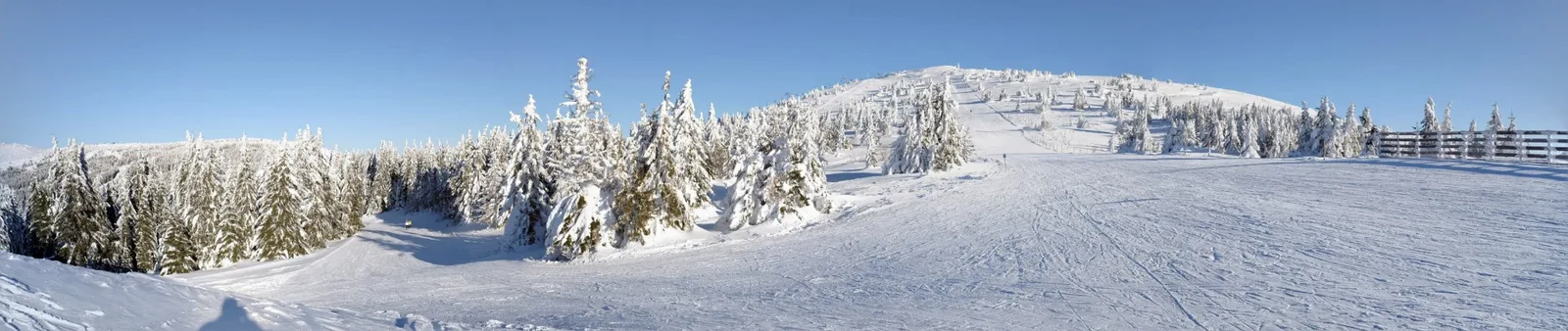
Kopaonik — National Park and Mountain Resort
Kopaonik is Serbia's largest mountain and most famous ski resort in southeastern Europe. Declared a national park in 1981, with Pančićev vrh at 2,017 m, the "mountain of sun" enjoys nearly 200 sunny days a year, endemic flora, rich wildlife, and centuries of mining and medieval heritage.
Kopaonik is Serbia's largest mountain and one of the most significant national parks in the Balkans. Its high plateau averages around 1,700 m above sea level, with Pančićev vrh at 2,017 m as the highest peak. With nearly 200 sunny days a year, Kopaonik rightfully bears the name "mountain of the sun" — its southern exposure and open terrain prevent prolonged cloud cover.
National Park
Kopaonik National Park was established in 1981, covering 11,800 ha with a buffer zone of 19,985 ha and strictly protected wildlife refuges on 698 ha. The park encompasses the mountain's highest areas and protects 13 natural reserves:
- Kozje stene — relict communities of spruce, fir and heather
- Vučak — unique fir and spruce community found only here and on Zlatar
- Jankova bara — the largest peat bog on Kopaonik, over a thousand years old
- Jelovarnik — waterfall with three cascades totalling 70 m, surrounded by beech, fir and spruce forest
- Suvo Rudište — high-mountain terrain at the upper treeline, with blueberry, dwarf juniper and sub-alpine spruce communities
- Gobelja, Barska reka, Samokovska reka, Mrkonja, Metodje, Jelak, Duboka, Bele stene — further strictly protected ecosystems
Geology and Relief
The landscape of Kopaonik began forming some 70 million years ago, when older sedimentary rocks were seized by powerful tectonic forces and penetrated by volcanic activity. The resulting geological diversity — granites, serpentinites, schists, marbles, andesites, limestones — is exceptional. Mineral wealth (iron, lead, zinc, silver, gold, wollastonite, fluorite) gave the mountain its very name: kopati means to mine, and people have mined here since antiquity. The mountain also harbours lightly mineralised cold springs, including the mildly radioactive Krčmar and Marina springs at 1,700–1,950 m.
Flora
Kopaonik sits at the boundary of the Illyrian and Moesian Balkan provinces, giving it exceptionally rich plant life. Forest zones rise from mixed oak, hornbeam and wild pear communities in the foothills through dense beech forests with maple, ash and fir, to spruce forests above 1,500 m. At 1,750–1,900 m, spruce gives way to dwarf juniper and blueberry scrub. The mountain's peat bogs — Jankova bara, Crvene bare, Barska reka — are over a thousand years old. Medicinal plants (St John's wort, thyme, yarrow) and endemic species including Leontopodium alpinum (edelweiss) are found throughout.
Fauna
Wildlife on Kopaonik includes wolf, roe deer, fox and hare, alongside the long-eared owl, rock partridge and the crossbill, which feeds on conifer seeds. Brown trout thrives in the clear waters of the Samokovska river. In the high cold zones lives the Siberian grasshopper, a rare species for this part of Europe.
Historical Heritage
The Kopaonik area bears traces of pre-Illyrian, Illyrian and Roman settlement. The remains of an early Christian basilica from the 4th–5th century were uncovered in 1999 at Crkvina – Nebeska Stolica, at 1,800 m. Medieval charters of Stefan Nemanja record this region as a župа in the Ibar valley — the heartland of the medieval Serbian state. Fortified towns Zvečan, Maglič, Brvenik, Vrh Lab and Koznik guarded the fertile plains and the mountain's ore wealth. Nearby monastic endowments of the Nemanjić, Lazarević and Branković dynasties — Studenica, Žiča, Sopoćani, Đurđevi Stupovi — attest to the region's central role in Serbian history. The Kopaonik mining district flourished in the 14th–15th centuries, trading with Dubrovnik, Byzantium and Western Europe.
Ski Resort and Mountain Activities
Kopaonik is Serbia's largest ski resort, offering ideal conditions for active holidays throughout the year. Snow cover lasts from late November to May — on average 159 days, with annual precipitation over 1,000 mm. The mountain air, enriched with oxygen and ozone by its beech forests, is recommended for people with asthma and respiratory conditions; Kopaonik has long been known as a "factory of red blood cells". At around 1,700 m, the resort offers hotels, sports facilities, cross-country trails and marked hiking paths accessible year-round.